Domain-Driven Design (DDD) offers a powerful way of managing complex domain logic by breaking it down into more manageable parts. One such part is the Aggregate, a pattern that plays a crucial role in maintaining the integrity of data and enforcing business rules.
What is an Aggregate?
An Aggregate is a cluster of domain objects that can be treated as a single unit for data changes. At the heart of an Aggregate is the Aggregate Root, an entity that ensures the consistency of changes being made within the Aggregate.
Role of an Aggregate
Aggregates serve to:
- Enforce business rules
- Ensure data consistency
- Simplify complex domain models
- Reduce coupling between different parts of the domain
Example: E-Commerce Customer and Order Scenario
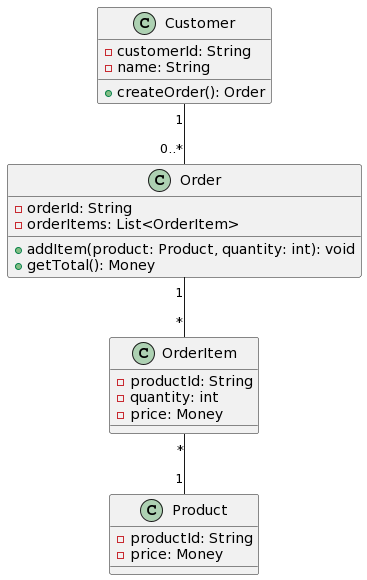
Consider an e-commerce platform where customers place orders for products. Here’s how we might model this using the Aggregate pattern.
Class Design
Customer: An entity representing a customer.Order: The Aggregate Root entity, encapsulating all order-related operations.OrderItem: A Value Object representing an item within an order.
PlantUML Class Diagram
Implementation in Python
class Customer:
    def __init__(self, customer_id, name):
        self.customer_id = customer_id
        self.name = name

    def create_order(self):
        return Order()

class Order:
    def __init__(self):
        self.order_items = []

    def add_item(self, product, quantity):
        self.order_items.append(OrderItem(product, quantity))

    def get_total(self):
        return sum(item.get_price() for item in self.order_items)

class OrderItem:
    def __init__(self, product, quantity):
        self.product = product
        self.quantity = quantity

    def get_price(self):
        return self.product.price * self.quantity

class Product:
    def __init__(self, product_id, price):
        self.product_id = product_id
        self.price = price
Example Usage
customer = Customer("123", "John Doe")
order = customer.create_order()
product = Product("prod-001", 100)
order.add_item(product, 2)
print(order.get_total())
In this scenario, Order is the Aggregate Root. It ensures that all changes to OrderItem objects are consistent with the business rules of the e-commerce domain. This design simplifies interactions with the domain model and maintains data integrity.
With the Aggregate pattern, DDD enables us to design complex systems in a more structured and maintainable way. By focusing on business rules and data integrity, Aggregates play a vital role in building effective domain models.