In this article, we’ll explore the main concepts of SID (Shared Information Data model) and DDD (Domain-Driven Design), their differences and connections, especially in terms of design patterns, and which design patterns from DDD can be found in SID. Moreover, we’ll discuss how SID facilitates faster modeling.
SID (Information Framework)
SID is a comprehensive information model aimed at providing a shared set of information definitions and models for communication service providers. Part of the TM Forum, it’s designed to support the implementation and exchange of business processes and services. SID standardizes the expression of business information by defining business entities (like customers, products, services, etc.) and their relationships.
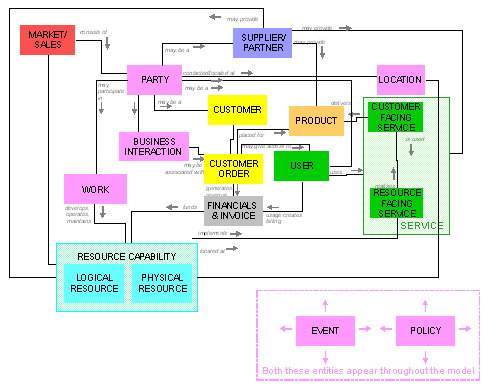
DDD (Domain-Driven Design)
DDD is a software development approach that emphasizes building software based on the complexity of the business domain. It advocates for aligning the software’s structure and language with the business model, promoting the development of software projects. DDD employs a series of patterns to identify and design domain models, including entities, value objects, aggregates/aggregates root, domain services, domain events, and more.
Differences and Connections Between SID and DDD
Objectives and Scope:
- SID: Focuses on providing a generic, standardized information model for the telecom industry to support business processes and data exchange.
- DDD: Concentrates on guiding software design through a deep understanding of the business domain; a more general software development methodology.
Design Patterns and Concepts:
- SID: Utilizes various design patterns, such as entities, relationships, specification patterns common in data modeling, and business analysis.
- DDD: Also employs design patterns, such as aggregates, entities, value objects, which help in defining domain models and bounded contexts.
Connection:
Both SID and DDD utilize a range of design patterns and concepts to organize and describe business information and logic. Although they target different backgrounds and goals, both emphasize understanding the business domain and accurately representing models.
DDD Design Patterns in SID
In SID, echoes of DDD concepts are visible, particularly in how data is organized and how entities and their relationships are defined. For example, SID’s entities and relationships find their counterparts in DDD’s entities and value objects. However, SID’s primary focus is on standardizing data models rather than the software design and development process emphasized in DDD.
SID Content That Facilitates Faster Modeling
- Standardized Entity and Relationship Definitions: Offers a widely recognized set of business entity and relationship definitions, accelerating understanding and modeling of the telecom business domain.
- Layering and Categorization of Business Entities: By assigning entities to different domains and subdomains, it aids modelers in quickly locating and understanding relationships between business entities.
- Predefined Patterns and Practices: SID provides a set of best practices and patterns, such as representing complex business rules and relationships, serving as a modeling starting point and reducing the need to start from scratch.
In conclusion, while SID and DDD differ in objectives and scope, they share common ground in their use of design patterns and focus on business domain modeling. Some design patterns and concepts in SID are similar to DDD, and it helps users quickly understand and model the telecom business domain by providing a standardized, industry-specific information model.